Friday, 13 April 2012

Daily Forex Brief London: Friday 13th April 2012


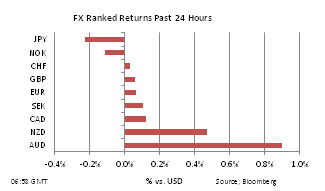
The big question this morning for markets is whether to meet the latest Chinese GDP data with concern that it was lower than expected, or relief that the economy is slowing in an orderly fashion and will be supported by the largest increase in yuan-lending for a year. The initial reaction, as suggested by the Aussie's movement, is that concerns are more about the slower than expected pace of growth, AUD down around 0.5% in the wake of the release. The yen is also the only leader vs. the dollar after the numbers. Also seen were modestly firmer industrial production numbers for March (11.9% YoY) and retail sales figures, which were in line with expectations at 14.8%. China is juggling a lot of balls right now, trying to slow the economy a little, rebalance it towards consumption, ensure that property prices soften rather than crash and control lending so it does not fuel potential new bubbles. For now, it looks like policy-makers are achieving their goals but it's a precarious balance.

Also in today's Daily Forex Brief:
  • Monti's continuing battle
  • Housing still a big US headwind
  • The impending franc attack

Thursday, 12 April 2012

Daily Forex Brief London: Thursday 12th April 2012


Bolstered by some reasonably encouraging growth data, the mood in Asia overnight has been constructive, with broad gains in the major bourses of around 1%. Both Australia and South Korea recorded better than expected employment outcomes last month; in the latter, the unemployment rate fell to 3.4% in March from 3.7% previously. In both Malaysia and the Philippines, exports soared by 15% in the most recent month. Also, Fed Vice Chairman Yellen gave her imprimatur to the Fed's highly accommodative stance (she was hardly going to say anything else, now was she?), and the Fed's Beige Book showed that all twelve regions are growing and that key indicators such as manufacturing, jobs and retail sales are showing signs of strength. Asian currencies are generally stronger overnight – the Aussie for instance is now at 1.04, up from yesterday's three-month low of 1.0226. Asia's better tone was assisted by a slightly more sanguine session in Europe. Apart from some speculation that the ECB might be prepared to re-charge its SMP to bring down Spanish government borrowing costs, there was some good news to emerge from various US companies at the commencement of the latest reporting season. Yesterday's improvement may prove to be merely a brief respite – despite the best endeavours of the Rajoy government it is clear that the Spanish economy is going backwards at a rapid rate. Europe's leaders will need to get its frequent-flyer cards ready because we can expect a lot more of those legendary late-night meetings over coming months.

Also in today's Daily Forex Brief:
  • Chinese currency calm
  • Will ECB be Saviour or Grim Reaper?

Wednesday, 11 April 2012

Daily Forex Brief London: Wednesday 11th April 2012


European stocks were down once again yesterday; the Euro STOXX 50 index has fallen in seven of the past nine sessions and is not far off flat for the year. The Nikkei has also sold off for the seventh consecutive session. It seems that for most of the year to date, investors have been able to hang on to the perception that the US economy is gaining traction and the eurozone credit crisis, if not past its worse, had at least moved back from peering over the cliff edge. This is not totally unfamiliar territory for markets, given we've seen several periods since 2009 during which markets have priced in a sustained recovery, with reality then choosing to bite. For FX, it's the traditional safe-havens that are taking the strain, the yen having unwound around one third of the recent depreciation and the Swiss franc battling with the ceiling imposed by the SNB.

Also in today's Daily Forex Brief:
  • SNB vs. the markets
  • Turbulent times down under
  • Spain's struggle

Tuesday, 10 April 2012

Daily Forex Brief London: Tuesday 10th April 2012


In the wake of the US jobs numbers on Friday, which saw the dollar softer as QE3 talk was once again re-ignited, the dollar has continued south, although only modestly so, the dollar index down around a further 0.2% in the aftermath of the release. In sum, the weaker headline payrolls data should be put in the context of what has been very strong labour market data over the past six months, above and beyond the messages from elsewhere in the economy. So if last week's release went some way to narrowing this gap, perhaps that is not such a bad thing after all? Furthermore, the numbers were not overly bad, with the unemployment rate still falling and manufacturing employment growing more strongly than expected. The Fed is still likely to put a lot of conditionality on further quantitative easing, a view Friday's numbers should not change

Also in today's Daily Forex Brief:
  • The impending battle on the Swissie
  • China back to black
  • The struggle for stimulus in Japan

Thursday, 5 April 2012

Daily Forex Brief London: Thursday 5th April 2012


On a day when the robustness of the US recovery stood in sharp contrast to the continuing difficulties being experienced in Europe, it was little wonder that the dollar consolidated the gains witnessed the previous day in response to the hawkish FOMC Minutes. From the respectable ADP jobs figures to the decent auto sales numbers and signs of a tightening rental market, the prognosis for the US economy does have a healthier glow. However, in Europe, ECB President Draghi spoke about downside risks to the economic outlook after a 0.3% decline in euro-area GDP in the final quarter of 2011. To make matters worse, the Spanish bond auction went poorly. As a result, risk appetite waned, the euro swooned and commodities headed south. The single currency threatened 1.31 at one stage – a couple of days ago 1.34 was in sight; EUR/JPY traded at 108 after nearly touching 110. Equities did not like the more hawkish stance on monetary policy from either the Fed or the ECB, with the German DAX down nearly 3%. Gold was a big loser – prior to the Fed Minutes it was up near USD 1,680 but by yesterday afternoon had fallen USD 60 to a three-month low of USD 1,620. Peripheral European bond yields rose sharply; the Spanish 10yr yield was up more than 20bp at 5.63%. Investors and traders were collectively throwing their toys out of the cot at the prospect of the major central banks no longer supplying them with perpetual free liquidity. Just like an alcoholic denied their liquor, threatening to withdraw liquidity from heavily-addicted asset markets can have very nasty consequences


Pages